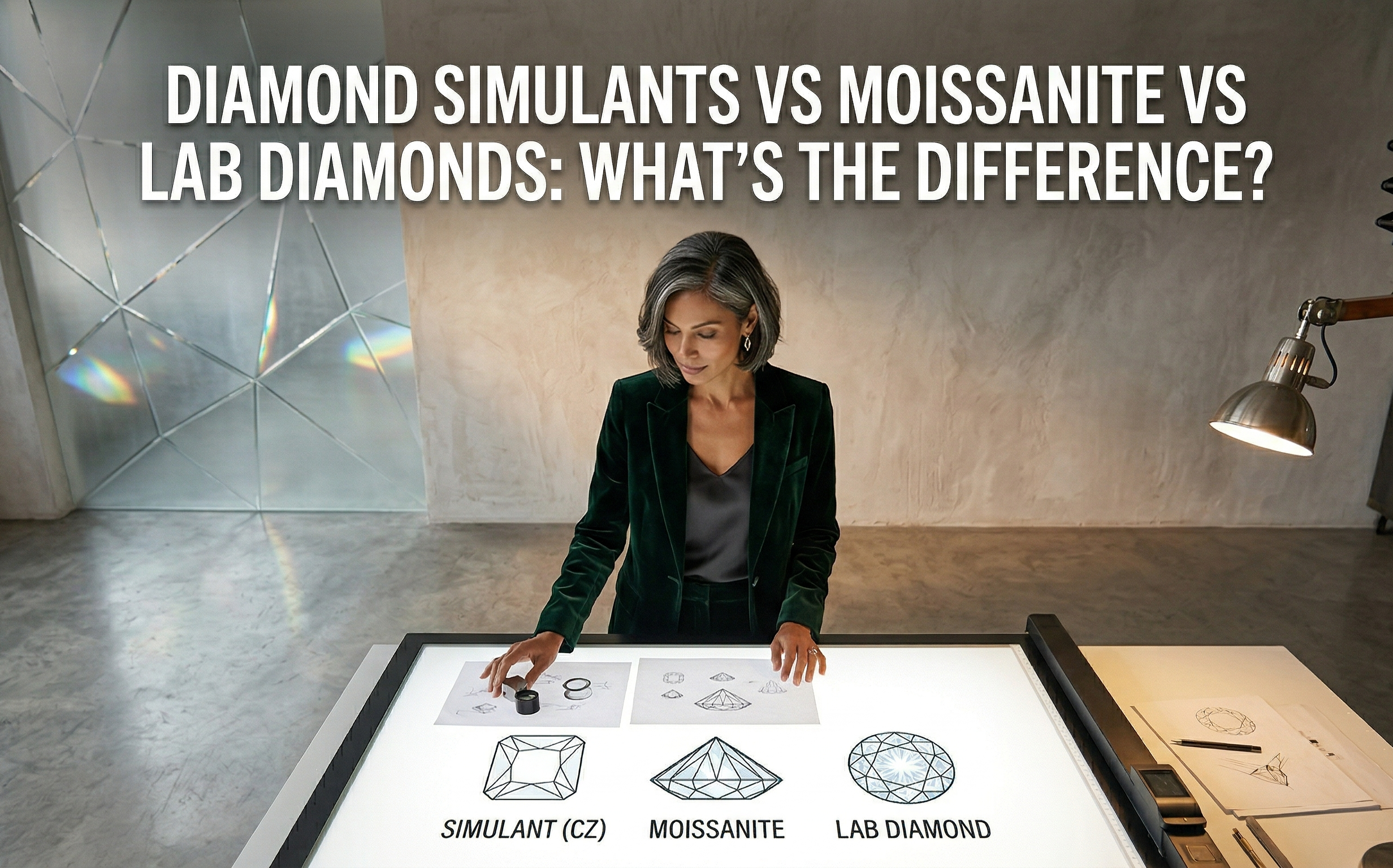
Diamond Simulants vs Moissanite vs Lab Diamonds: What's the Difference?
Not All Diamond Alternatives Are Created Equal
The jewellery market today offers more choice than ever before. Walk into any jewellery store in Hyderabad's Abids or browse online, and you will encounter terms like cubic zirconia, moissanite, and lab-grown diamonds — often in the same breath. But these are very different products with very different properties. Understanding the distinctions will help you make a purchase you will be genuinely happy with.
Diamond Simulants: The Look-Alikes
Diamond simulants are materials that visually resemble diamonds but are chemically and physically completely different. The most common simulants include cubic zirconia (CZ), white sapphire, white topaz, and glass.
Cubic zirconia is the most widely sold simulant. It has a high refractive index and initially looks quite brilliant. However, it scores only 8 to 8.5 on the Mohs hardness scale and scratches easily with everyday wear. Over time, CZ becomes cloudy and dull. White sapphire and topaz are harder but still significantly softer than diamond and lack its distinctive fire.
Simulants are best understood as fashion jewellery materials — they are inexpensive and serve a purpose, but they do not replicate the durability or longevity of a diamond.
Moissanite: The High-Performance Simulant
Moissanite occupies a fascinating middle ground. It is not a diamond — it is a completely different mineral, silicon carbide — but it has some remarkable properties. It scores 9.25 on the Mohs scale, making it very durable. It has a higher refractive index than diamond, producing even more sparkle and fire — so much so that some people actually find it too brilliant, with a distinctive disco-ball effect in direct sunlight.
Modern lab-created moissanite is available at a fraction of the price of both lab-grown and natural diamonds. It is a legitimate jewellery material and suits buyers who want maximum sparkle on a tight budget. However, it is not a diamond and should not be represented as one.
Lab-Grown Diamonds: The Real Thing
Lab-grown diamonds are not simulants and are not moissanite. They are genuine diamonds — the same chemical composition, the same hardness (10 Mohs), the same brilliance profile, and the same durability as natural diamonds. The distinction is critical.
Unlike moissanite, which looks different from diamond under magnification and to trained eyes, lab-grown diamonds are indistinguishable from natural diamonds by any conventional means. Unlike CZ, they do not cloud or scratch over time.
Side-by-Side Comparison
Hardness: Natural Diamond 10, Lab Diamond 10, Moissanite 9.25, CZ 8–8.5.
Chemical composition: Natural Diamond = pure carbon, Lab Diamond = pure carbon, Moissanite = silicon carbide, CZ = zirconium oxide.
Appearance over time: Natural Diamond retains brilliance indefinitely, Lab Diamond retains brilliance indefinitely, Moissanite retains brilliance well, CZ clouds and dulls within a few years.
Price per carat (approx. India): Natural Diamond = highest, Lab Diamond = 70–85% less than natural, Moissanite = significantly lower than lab diamond, CZ = minimal cost.
Which Should You Choose?
If you want a genuine diamond — the real prestige, the certified quality, the lifelong durability — at an affordable price, a lab-grown diamond is your answer. If you are on a very tight budget and primarily want sparkle for fashion jewellery, moissanite is an honest, durable option. Avoid CZ for any piece you want to keep and treasure long-term.
Conclusion
For Hyderabad jewellery buyers seeking a diamond engagement ring, bridal jewellery, or a lasting fine jewellery piece, lab-grown diamonds deliver genuine diamond quality without the natural diamond price tag. They stand in a completely different category from simulants and moissanite — and knowing this distinction will ensure your jewellery investment is one you are proud of for decades.