Do Lab-Grown Diamonds Hold Value? The Truth Explained
Before buying any diamond, a sensible buyer asks: what will this be worth later? In India, where jewellery has always doubled as savings, it's a fair question. Here's an honest answer about lab-grown diamond value, without the spin.
How natural diamond value works
Natural diamonds have long been marketed as rare, and big mining companies have managed supply for decades to keep prices stable. That, plus cultural attachment, helps them hold some resale value. But even natural diamonds lose a large share of their retail price the moment you buy them. You rarely sell a diamond for what you paid.
Lab-grown diamond prices have been falling
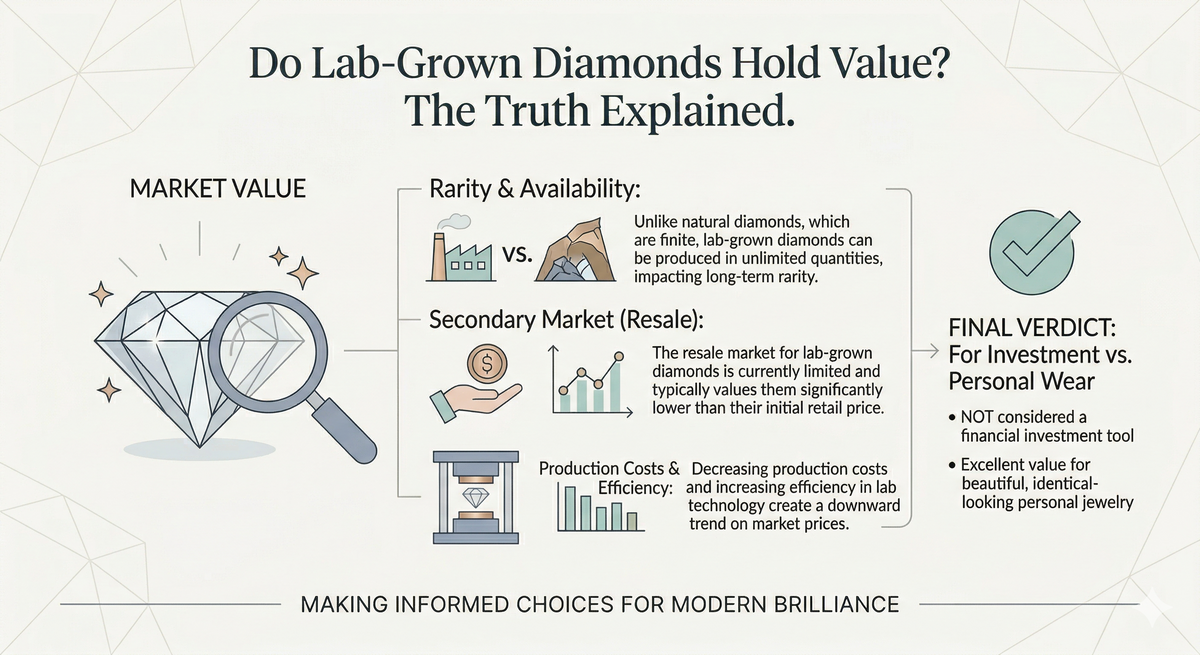
Lab-grown diamond prices have dropped a lot over the last five years as technology improved and production scaled up. A few years ago, a one-carat lab diamond sold for roughly 40% less than a natural equivalent. Today the gap is 70–85%, depending on quality.
That's great news if you're buying now: you get far more diamond for your money. The flip side is that a lab diamond bought a few years ago at a higher price will have a lower market value today.
Should you treat lab diamonds as an investment?
Honestly, no, and the same is largely true for natural diamonds for most buyers. Neither behaves like gold or equity. Natural diamonds have a stronger resale network, but even they sell well below retail.
Buy lab-grown diamonds for the beauty, the meaning and the joy of wearing them, not for a financial return. We go deeper in are lab-grown diamonds a smart investment in India?
Why your jeweller's buyback policy matters most
Because the open resale market for lab-grown diamonds is still young, the single biggest factor in what your piece is worth later is the buyback promise of the jeweller you buy from. Many offer little or nothing.
At SIYARI, every piece comes with an 80% buyback guarantee. That protects the value of your jewellery in a way the open market currently doesn't. Read our buyback and exchange policy for the details.
Where lab diamonds win: value at purchase
Resale may favour natural diamonds, but purchase value is overwhelmingly on lab-grown's side. Instead of a half-carat natural diamond for around ₹2 lakh, you could buy a much larger lab-grown diamond for a fraction of that. The daily joy of wearing a bigger, better stone outweighs the theoretical resale edge of a small natural one.
The long view
As lab-grown diamonds become mainstream, some analysts expect prices to stabilise and a stronger resale market to develop. That's speculative, and the market is young. For pure wealth preservation, gold remains the traditional Indian choice. For the most beautiful diamond your budget can buy, lab-grown wins.
The bottom line
Value lab-grown diamonds for what they give you today: beauty, certified quality, ethical sourcing and remarkable affordability. Buy from a jeweller whose buyback terms protect you, and you get the best of both.
See real prices in our carat-wise price guide, or book a visit to our studio in Somajiguda, Hyderabad.