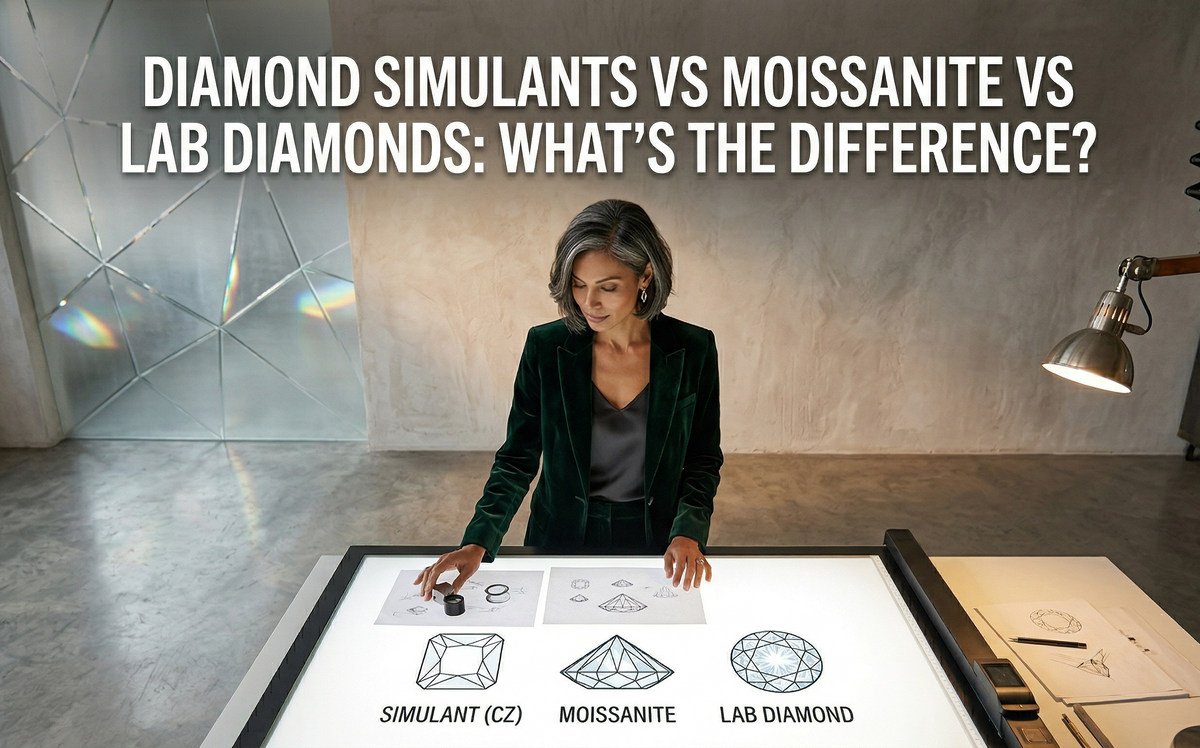
Diamond Simulants vs Moissanite vs Lab Diamonds: What's the Difference?
Cubic zirconia, moissanite, lab-grown diamond: you'll often hear them mentioned in the same breath, online or in a store. But they're very different materials, and knowing the difference means buying something you'll be happy with for years.
Diamond simulants: the look-alikes
Simulants only look like diamonds. The common ones are cubic zirconia (CZ), white sapphire, white topaz and glass.
CZ is the most common. It looks bright at first, but at 8–8.5 on the Mohs hardness scale it scratches easily and turns cloudy and dull over time. White sapphire and topaz are harder but still much softer than diamond and lack its fire. Simulants are fine for fashion jewellery, not for pieces you want to keep.
Moissanite: the high-sparkle alternative
Moissanite is a different mineral entirely: silicon carbide. It's tough (9.25 on the Mohs scale) and has more fire than diamond, which some people love and others find a little too much, with a rainbow, disco-ball flash in sunlight.
It costs less than lab-grown diamonds and is an honest choice for maximum sparkle on a tight budget. But it isn't a diamond and shouldn't be sold as one.
Lab-grown diamonds: the real thing
Lab-grown diamonds aren't simulants and aren't moissanite. They're genuine diamonds with the same chemistry, the same hardness (10), the same brilliance and the same durability as mined diamonds. Unlike moissanite, they can't be told apart from mined diamonds by conventional means. Unlike CZ, they won't cloud or scratch over time.
Side by side
| Natural diamond | Lab-grown diamond | Moissanite | Cubic zirconia | |
|---|---|---|---|---|
| Material | Pure carbon | Pure carbon | Silicon carbide | Zirconium oxide |
| Hardness (Mohs) | 10 | 10 | 9.25 | 8–8.5 |
| Over time | Keeps its brilliance | Keeps its brilliance | Keeps it well | Clouds and dulls |
| Price | Highest | 70–85% less than natural | Lower than lab-grown | Minimal |
| Is it a diamond? | Yes | Yes | No | No |
Which should you choose?
If you want a real diamond, with certified quality and lifelong durability, at an affordable price, choose lab-grown. If you're on a very tight budget and want sparkle for fashion jewellery, moissanite is a durable, honest option. Avoid CZ for anything you want to keep.
The bottom line
For an engagement ring, bridal jewellery or any piece you'll wear for decades, lab-grown diamonds give you genuine diamond quality without the natural diamond price. Not sure they're real? Read are lab-grown diamonds real?
Every SIYARI diamond is IGI-certified, so you always know you're getting the real thing. Book a visit to compare stones in person at our studio in Somajiguda, or browse our rings.